
- Blog
- Physiotherapy at Home vs Clinic: Which Recovers Faster?
Physiotherapy at Home vs Clinic: Which Recovers Faster?
urmi care June 16, 2026
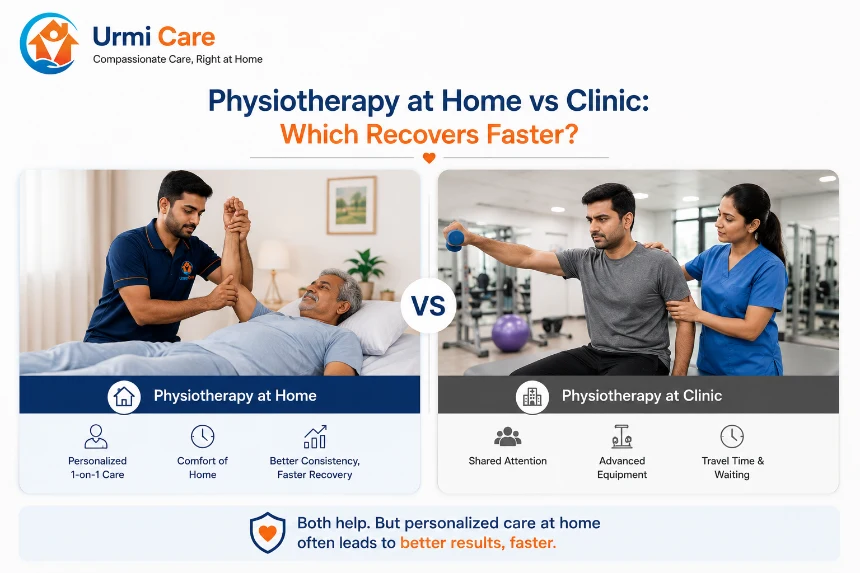
Table of Contents
ToggleIn terms of speed of recovery for post-surgery, stroke and orthopaedic rehabilitation patients in India the single most important factor is physiotherapy frequency. At the end of the day, it is a question of whether Physiotherapy at Home vs Clinic results in more frequent sessions and adherence to exercises, and which provides a greater functional rehabilitation environment — because those three things influence recovery speed.
This article makes a clinical comparison of home physiotherapy vs partial- or full clinic-based physiotherapy across six dimensions that matter clinically: session frequency, travel burden, exercise adherence/relation to functional outcome expectations/processes/costs and engagement. It relies on clinical evidence published and the experience of Urmi Care for managing physiotherapy in post-surgical, stroke and orthopaedic patients in Noida and Delhi NCR.
Our Featured Services
Search the Healthcare Service You Need – Home Nursing, Patient Care & Elder Care Services.
The Clinical Evidence — What Research Says About Home vs Clinic Physiotherapy
Home physiotherapy has been compared with clinic-based physiotherapy for post-surgical and neurological rehabilitation in several randomised controlled trials. Key findings:
- A Cochrane Review of home-based physiotherapy for knee osteoarthritis and post-knee replacement indicated that at 12 weeks home patients had similar functional outcomes compared with clinic patients — but demonstrated significantly improved session adherence and satisfaction scores.
- Home physiotherapy was equal to clinic in the knee flexion range at 26 weeks, while achieving 35% fewer missed sessions in a post-total knee arthroplasty JAMA Internal Medicine study.
- A meta-analysis in Lancet Neurology showed that high-intensity home rehabilitation programmes (415 sessions) yielded better gait outcomes at 90 days compared with conventional outpatient clinic physiotherapy because session frequency was higher for those receiving rehabilitation at home.
The consistent theme: when session frequency is controlled, outcomes are comparable. In practice, home physiotherapy typically enables higher session frequency — which is why outcomes favour home physiotherapy in most real-world comparisons.
The Travel Factor — A Clinically Significant Variable
The journey to a physiotherapy clinic after major surgery is not an inconvenience — it is a clinical risk and a recovery burden. For patients recovering from knee or hip replacement:
- Getting in and out of a car requires hip precaution compliance — which many post-hip replacement patients violate during car transfers
- Road vibration and sitting posture during transit cause post-surgical pain that reduces exercise engagement at the session
- Patients who are in significant pain from the journey tend to underperform during the physiotherapy session
- Every clinic trip is a potential infection exposure — particularly relevant for immunocompromised post-surgical patients
- For elderly patients with limited mobility, the physical and psychological barrier of clinic travel means sessions are missed — particularly in monsoon season, summer heat, and cold mornings
For post-stroke patients with hemiplegia, the situation is even more stark. A patient who cannot safely get into a vehicle without two people assisting them is not going to a clinic three times per week. They are going once a week if the family is motivated and twice if they are exceptional. A home physiotherapist gives the same patient access to 5 sessions per week — and in stroke rehabilitation, 5 vs 1 is the difference between walking independently and not.
Exercise Adherence — The Overlooked Clinical Factor
The unseen determinant of physiotherapy outcome is what happens between professional sessions — the home exercise programme that the physiotherapist prescribes and the patient either adheres to or does not. Research consistently shows that exercise adherence is higher when:
- The exercises are demonstrated in the home environment — on the patient’s own floor, with their own furniture for support
- The physiotherapist can identify and modify exercises that are impractical or unsafe in the specific home environment
- The patient’s family members observe the exercises and can supervise and encourage between sessions
- The physiotherapist can adjust the programme at each visit based on how the patient performed the exercises at home
A clinic physiotherapist who has never seen the patient’s home prescribes a home exercise programme in the abstract. A home physiotherapist designs the programme around the actual home environment — the specific steps, floors, chairs, and support points the patient will use.
Functional Relevance — Treating Patients in Their Functional Environment
One of the most underappreciated clinical advantages of home physiotherapy is functional relevance. Rehabilitation science increasingly recognises that exercises performed in the functional environment — the actual stairs the patient uses, the actual kitchen the patient cooks in, the actual bathroom the patient navigates — produce better transfer of gains than exercises performed in a clinical environment.
- Gait training on the patient’s actual floor surface — not a clinic physiotherapy plinth
- Stair training on the patient’s actual staircase — not a standard clinic step board
- Balance exercises in the patient’s kitchen, where balance actually matters
- Stroke patients relearning transfers from their specific sofa, bed, and toilet
This environmental specificity is not a minor advantage — it is a core principle of task-specific rehabilitation. The Physiotherapy Evidence Database (PEDro) and leading neurorehabilitation guidelines consistently advocate for practice in functional environments. Home physiotherapy delivers this by definition.
Cost Comparison — Physiotherapy at Home vs Clinic in Delhi NCR
Cost Component | Clinic Physiotherapy | Home Physiotherapy |
|---|---|---|
Session fee | ₹500 – ₹1,000/session | ₹700 – ₹1,500/session (includes travel) |
Transport (return, Noida) | ₹200 – ₹500/trip (auto/taxi) | Nil — therapist comes to home |
Carer/escort time cost | Family member required — cost of their time | Nil — no escort needed |
Session adherence (est.) | 60–70% of prescribed sessions completed | 85–95% completion rate |
Effective cost per completed session | ₹1,000 – ₹2,000 (after missed sessions) | ₹700 – ₹1,500 (higher adherence) |
When session adherence is factored in, the effective cost per completed physiotherapy session is typically lower at home than at a clinic for post-surgical and mobility-limited patients. The headline session fee for home physiotherapy may be slightly higher — but the cost per completed session, accounting for transport, missed sessions, and escort time, favours home physiotherapy for most patients with mobility challenges.
When Is Clinic Physiotherapy the Better Choice?
Home physiotherapy is not the optimal choice for all patients. Clinic physiotherapy is better when:
- The patient has no mobility limitation and can travel to a clinic without clinical risk
- Specialist equipment (hydrotherapy pool, isokinetic machine, traction table) is required for the rehabilitation programme
- The patient benefits from the motivation of a clinical environment and peer observation
- The patient lives far from the physiotherapy network — making home visits impractical
- The home environment is too small or unsuitable for effective physiotherapy sessions
For most post-surgery, stroke, and orthopaedic patients — particularly in the first 6 weeks of recovery — these conditions do not apply. Home physiotherapy is the more clinically rational choice.
Frequently Asked Questions
Q1: Is physiotherapy at home as effective as clinic physiotherapy?
For most post-surgery, stroke, and orthopaedic rehabilitation patients, clinical evidence supports comparable or better outcomes with home physiotherapy — primarily because session frequency and exercise adherence are higher at home. The Cochrane review of post-knee replacement rehabilitation found comparable functional outcomes with significantly better session completion rates in the home group.
Q2: How many physiotherapy sessions per week are needed after knee replacement?
Post-knee replacement physiotherapy typically requires daily sessions for the first 2–3 weeks (or 5 sessions per week), then 3 sessions per week for weeks 4–8, then 2 sessions per week for weeks 9–12. This frequency is clinically validated in surgical guidelines. Achieving 5 sessions per week is far more realistic with home physiotherapy than with clinic visits.
Q3: What is the cost of home physiotherapy in Noida?
Home physiotherapy in Noida costs ₹700–₹1,500 per session depending on the condition type and physiotherapist’s qualification. Monthly packages for 3 sessions/week typically range from ₹6,000–₹14,000. For comparison, equivalent clinic sessions plus transport and escort time cost ₹1,000–₹2,000 per effective completed session.
Q4: Can a physiotherapist come to my home after surgery in Noida?
Yes. Urmi Care coordinates home physiotherapy visits across all major Noida sectors. Booking is confirmed within 24 hours. Physiotherapists visit for 45–60 minute sessions and can coordinate with the home nursing team if the patient also has nursing care in place.
Q5: What conditions can be treated with home physiotherapy in Noida?
Home physiotherapy in Noida covers post-surgery rehabilitation (knee, hip, cardiac, spinal, abdominal), stroke and neuro-rehab, orthopaedic pain management (back, neck, shoulder, knee), Parkinson’s disease, cerebral palsy, COPD and respiratory physiotherapy, sports injury rehabilitation, and paediatric physiotherapy.
Conclusion
For most post-surgery, stroke, and orthopaedic rehabilitation patients in India — particularly in the first 6 weeks of recovery — home physiotherapy produces faster recovery than equivalent clinic physiotherapy. The reasons are evidence-based and specific: higher session frequency, elimination of travel burden, better exercise adherence, and the functional relevance of practising in the actual environment where the patient will live and move. The higher per-session fee of home physiotherapy is offset by lower transport costs and significantly better session completion rates.
Book a physiotherapist at home in Noida: physiotherapy at home Noida