
- Blog
- Home Nursing vs Hospital Care: Cost, Comfort & Recovery Compared
Home Nursing vs Hospital Care: Cost, Comfort & Recovery Compared
urmi care June 9, 2026
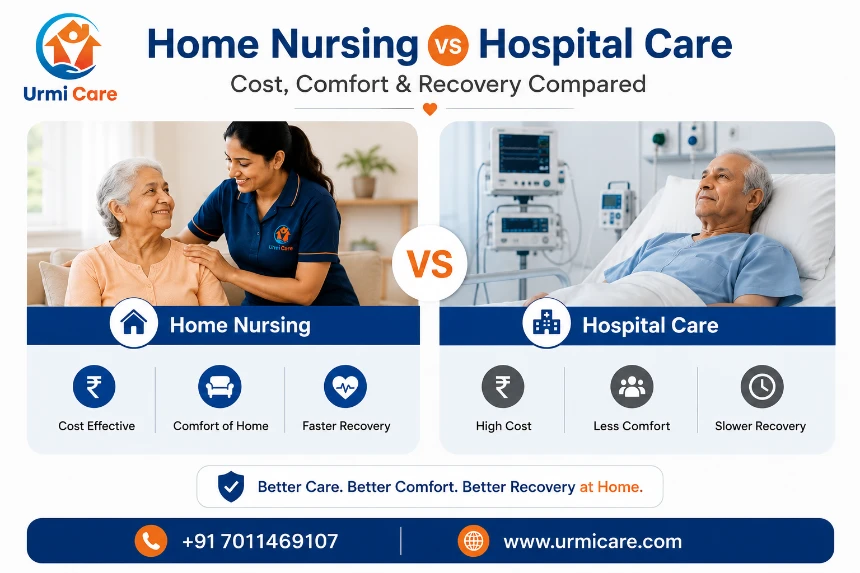
Table of Contents
ToggleWhen a family member is discharged from hospital — or when a doctor gives the family a choice between continued inpatient care and home recovery with nursing support — the question is genuine: Is home nursing actually as safe as staying in hospital? Will recovery be slower at home? What about the difference in cost? And what does the evidence say about outcomes?
This article compares home nursing and hospital care across six key dimensions that matter to Indian families: clinical safety, infection risk, cost, recovery outcomes, mental wellbeing, and what each option requires from the family. The goal is to help families make an informed, honest decision — not to promote one option over the other.
Our Featured Services
Search the Healthcare Service You Need – Home Nursing, Patient Care & Elder Care Services.
1. Clinical Safety — Is Home Nursing as Safe as Hospital Care?
The review is clear; for medically stable patients, home nursing under competent supervision provides clinical outcomes in an equal time frame as inpatient ward stays. A trial published in the Annals of Internal Medicine (Leff et al., 2005) compared hospital-at-home patients, matched for severity but treated at home with hospital controls and found less complications, reduced recovery time and higher patient satisfaction. Recent Indian data from AIIMS and Apollo-affiliated researchers have corroborated these findings in postoperative and chronic disease management patients.
The critical word is stable. This is not suitable for those who are haemodynamically unstable, needing urgent surgical intervention or those where the diagnosis requires hospital based equipment or specialist access. The uncommentable first condition is the judgement of his medical stableity by the treating doctor before discharge.
For stable patients — post-operative recovery, aged care, chronic disease management, post ICU step down — clinically safe if qualified home nursing is present with a structured care plan per pro forma template and daily documentation of observations/review with pre-agreed action thresholds. Urmi Care’s home nursing arrangements in Noida composes all 3 that is structured care plan, daily logs and a guaranteed response from the clinical coordinator immediately within 30 minutes for escalations.
2. Hospital-Acquired Infections — A Significant Risk in Extended Inpatient Stays
Hospital-acquired infections (HAIs) which is often one of the most overlooked pitfalls with extended hospital stays. According to the WHO, an estimated 10% of patients in high-income countries and up to a quarter of patients in low-resource settings acquire an HAI during a hospital stay. MRSA, C. difficile and catheter-associated urinary tract infections are reported HAI problems in Indian hospitals.
Home nursing eliminates this risk entirely. A patient recovering from knee replacement surgery in their own home — with a dedicated nurse following sterile wound care technique — has zero exposure to the drug-resistant organisms that circulate in hospital environments. This represents perhaps the largest medical justification for refusing to have post-surgical recovery anywhere other than home.
3. Cost Comparison — Home Nursing vs Hospital in India
In India hospital ward stas are 61% higher than at qualified home nursing. Let’s say you are a patient preparing to undergo knee replacement surgery and will need 21 days of post-operative rehabilitation:
Care Component | Hospital Ward (21 days) | Home Nursing (21 days) |
|---|---|---|
Room/accommodation | ₹2,500–₹6,000/day = ₹52,500–₹1,26,000 | Not applicable — patient’s own home |
Nursing care | Included in ward rate | ₹18,000–₹28,000/month (12-hr day nurse) |
Daily meals | ₹400–₹800/day included in hospital rate | Home-prepared meals — patient preference |
Physiotherapy | ₹500–₹800/session billed separately | ₹700–₹1,200/session home visit |
Wound dressing (daily) | Included in ward rate | ₹400–₹700/visit or included in nurse’s shift |
Approximate 21-day total | ₹70,000 – ₹1,80,000+ | ₹25,000 – ₹45,000 |
These are indicative figures based on Noida and Delhi NCR hospital rates in 2026. Private hospital ward rates in premium facilities can be significantly higher. Home nursing costs represent Urmi Care’s standard 12-hour day shift rates. The cost difference is real — and it compounds significantly for longer recovery periods (elder care, chronic disease management, palliative care).
4. Recovery Outcomes — Does the Setting Affect How Fast Patients Recover?

Home nursing has over a hospital ward three factors in home nursing that influence recovery outcomes: your own environment, unbroken individual continuity of care and institutional stress absence.
- Familiar environment: When in their own homes, patients show significantly lower levels of cortisol (the key stress hormone that has a direct effect on immune function and wound healing) than matched patients living in hospital settings. This has been recorded in several physioligical studies.
- Sleep quality: Hospital wards are noisy, disturbed environments. Patients at home sleep significantly better — and sleep is the single most important factor in post-surgical tissue repair.
- Nutritional intake: Home-prepared meals aligned with the patient’s preferences improve nutritional compliance. Hospital food compliance — particularly in elderly patients — is a documented problem.
- Mental engagement: Home-based recovery is less associated with hospital-induced depression and cognitive deterioration (important for older patients).
The clinical literature has repeatedly demonstrated equivalence or superiority of functional outcomes at 30 and 90 days after orthopaedic, cardiac and abdominal surgery recovery in home nursing patients vs matched
5. Mental Wellbeing — A Factor Medical Teams Underestimate
The psychological dimension of recovery is rarely factored into hospital vs home care decisions. Hospital environments create institutional dependency — particularly in elderly patients. Having other sick patients around you, waking for observations at 3 AM in the morning, no access to family (especially important if children), and a lack of personal routine etc all raise anxiety levels and dampen motivation to rehabilitate.
Home recovery preserves the patient’s identity and autonomy in ways a hospital ward cannot. Elderly patients are less likely to develop delirium at home. Post-surgical patients engage more actively with physiotherapy when they are in their own environment. Cancer patients receiving palliative care consistently report higher quality of life scores at home than matched inpatient palliative patients.
6. What Home Nursing Requires from the Family
6. What Home Nursing Requires from the Family
Home nursing is not a passive choice. It requires:
- A suitable home environment — space for a routine hospital bed if needed, updated bathroom access, ample light
- An experienced and reputable home care agency that screens its nurses, provides documentation and holds them accountable post placement
- Availability to hand over between family members, for emergency escalation and daily proceedings
- Clear communication with the treating doctor — the home nurse needs a care plan, not verbal instructions
- Willingness to trust but verify — Being prepared to trust, but checking that the care is delivering by reviewing their daily logs, going to do care
For families unable to satisfy those criteria — elderly patients living alone with no family in the vicinity, patients needing specialized equipment that remains permanently on site — extended hospital stay or a specialist nursing home may be more appropriate than home care.
Frequently Asked Questions
Q1: Is home nursing as safe as hospital care for post-surgery recovery?
For medically stable post-surgery patients, qualified home nursing produces clinical outcomes comparable to inpatient ward care — supported by multiple clinical studies. The critical conditions are medical stability confirmed by the treating doctor, a qualified nurse (not a caregiver), a structured care plan, and clear escalation criteria. For unstable patients, hospital care remains appropriate.
Q2: What are the main risks of home nursing compared to hospital care?
The main risks of home nursing are: inadequate nurse qualification (using a caregiver instead of a qualified nurse for clinical needs), lack of immediate specialist access for unexpected complications, and equipment limitations. These risks are managed by using a qualified agency that verifies nurses, ensuring the treating doctor has cleared the patient for home discharge, and maintaining clear escalation criteria with a hospital contact.
Q3: Is home nursing cheaper than hospital in India?
Yes — significantly. For a 21-day post-surgical recovery, hospital ward costs in Noida and Delhi typically run ₹70,000–₹1,80,000, while equivalent home nursing costs ₹25,000–₹45,000. The difference is larger in premium hospitals and longer stays. The cost saving is real and clinically justifiable for medically stable patients.
Q4: When should I choose hospital care over home nursing?
Hospital care is more appropriate when: the patient is medically unstable or deteriorating, specialist access (intensivist, surgeon on call, emergency imaging) may be needed within hours, the patient requires life support equipment not available at home, or the home environment cannot safely accommodate the patient’s needs. The treating doctor’s assessment is the definitive guide.
Q5: What is the biggest advantage of home nursing over hospital care?
For most post-surgical and chronic patients, the biggest combined advantage is the elimination of hospital-acquired infection risk, significantly lower cost, better sleep and nutritional outcomes, preserved mental wellbeing, and family presence — in an environment that supports recovery rather than institutional dependency.
Conclusion
Home nursing vs hospital care is not a simple either/or. It is a clinical decision that depends on the patient’s stability, the quality of the home nursing arrangement, and the family’s capacity to support the care. For the right patient — medically stable, in a supportive home environment, with a qualified nurse and a reliable agency — home nursing offers comparable clinical outcomes at significantly lower cost, with substantially better infection risk, sleep, nutrition, and mental wellbeing outcomes than a hospital ward.
For home nursing placement in Noida: Nursing Services at Home — Delhi NCR