
- Blog
- ICU at Home in India: When It’s Possible, When It Isn’t
ICU at Home in India: When It’s Possible, When It Isn’t
urmi care June 15, 2026
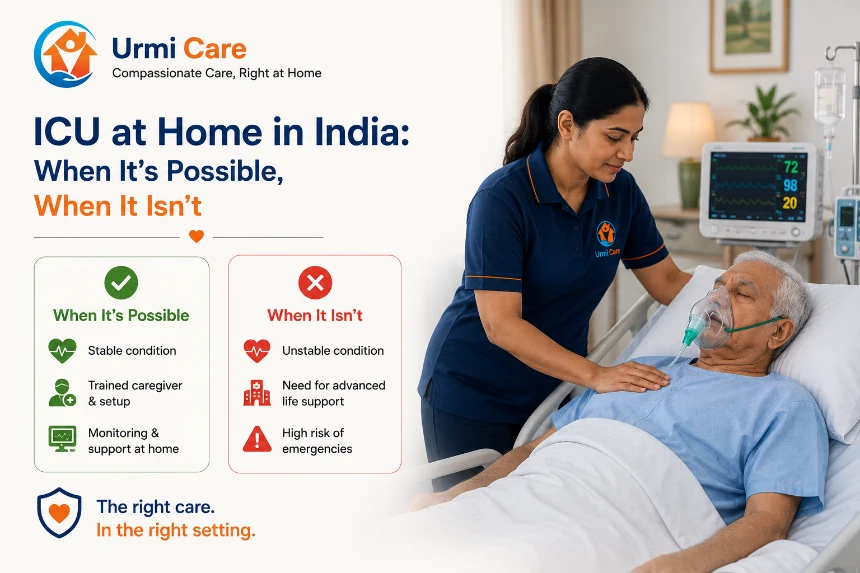
Table of Contents
ToggleThe idea of ICU-level care at home sounds counterintuitive until you understand what “ICU at home” actually means in clinical practice. It does not mean bringing a hospital ICU into a bedroom. It means providing the monitoring, nursing skill, and supportive equipment that allows a medically stable but dependent patient to remain at home rather than continuing an expensive, infection-risky inpatient stay.
For Indian families managing a loved one who has survived a serious illness — ARDS, severe stroke, cardiac surgery, prolonged pneumonia — the question “can we bring them home?” is one of the most important they will ask. This article explains the clinical criteria, the practical requirements, the costs, and the honest limitations of ICU at home in India.
Our Featured Services
Search the Healthcare Service You Need – Home Nursing, Patient Care & Elder Care Services.
What Is ICU at Home and What Does It Actually Provide
“ICU at home” in India refers to a home care arrangement that replicates the monitoring intensity and nursing skill of a hospital ICU, for a patient who is medically stable but still requires:
- Continuous clinical monitoring — BP, HR, SPO2, RR, temperature — every 2 hours
- Ventilator or BiPAP/CPAP support
- Tracheostomy care and suctioning
- Enteral feeding — Ryle’s tube or PEG tube
- Complex IV medication management
- 24-hour nursing by ICU-experienced staff
It does not provide emergency surgical capability, blood transfusion, dialysis, or specialist consultant attendance on demand. These remain hospital-only capabilities. The moment a home ICU patient needs any of these, the escalation protocol — transfer to hospital — is activated.
When Is ICU at Home Clinically Appropriate?
The four conditions that must all be met before a patient is appropriate for home ICU in India:
- Medically stable: The patient’s vital signs are within an acceptable range and not trending towards deterioration. “Stable” is defined by the treating intensivist — not the family.
- No need for hospital only interventions: Difficult air due to airway/possible anemia/gas exchange problems admission; emergency surgery, blood transfusion, invasive monitoring lines not livable at home or other specialist access within minutes.
- Clear care plan: The outside hospital will write an outpatient plan to your team that contains monitoring parameters, medication schedule and, when appropriate, ventilator settings as well as pre-determined escalation criteria defined. ventilator settings (if applicable) with predetermined escalation thresholds.
- Capable home environment:The patient has sufficient space for a hospital bed and other necessary equipment, 24-hour electricity reliability (very important in cases of patient who needs ventilation) and accessible entrance to accommodate an ambulance if necessary; A family member is available as first point of contact.
When Is ICU at Home NOT Appropriate?
The following patient situations are not appropriate for home ICU in India, regardless of family preference or cost considerations:
- Haemodynamically unstable patients — BP or heart rate requiring active vasopressor management
- Patients with rapidly evolving neurological condition — new strokes, expanding haematomas, decompensating intracranial pressure
- Active sepsis with worsening parameters — despite antibiotic therapy
- Patients requiring emergency haemodialysis
- Multi-organ failure patients not yet reaching stability plateau
- Patients whose families cannot realistically manage the logistical and emotional demands of home ICU
This last point is underappreciated. A home ICU arrangement places significant demands on the family — not clinical demands, but logistical, emotional, and decision-making demands. Families who are not genuinely prepared for this reality, and who take on home ICU because it is cheaper or because the hospital is uncomfortable, often regret the decision.
What Equipment Does a Home ICU Require?
The equipment requirements for a home ICU in India depend on the patient’s specific clinical needs. Common configurations:
Equipment | Clinical Purpose |
|---|---|
Electric hospital bed with side rails | Safe positioning, 2-hourly turning, head elevation |
Alternating pressure air mattress | Pressure sore prevention for bedridden patients |
Multi-parameter monitor | Continuous BP, HR, SPO2, temperature, RR tracking |
Oxygen concentrator or cylinder | Supplemental oxygen delivery at prescribed flow rate |
Suction machine | Oral, pharyngeal, tracheal secretion clearance |
BiPAP / CPAP / Ventilator | Non-invasive or invasive ventilation for respiratory support |
Ryle’s tube / PEG feeding set | Enteral nutrition delivery for non-oral patients |
IV infusion pump (optional) | Accurate rate-controlled IV medication delivery |
Nebuliser | Inhaled medication delivery for respiratory patients |
Glucometer and BP cuff | Bedside monitoring — glucose and BP every 2–4 hrs |
Medical equipment on rent in Noida: medical equipment on rent Noida.
What Does Home ICU Cost in India?
Home ICU in India costs 50–70% less than equivalent inpatient ICU stays — the primary cost drivers being the absence of hospital overhead, ward charges, and daily facility fees. Indicative costs for Noida and Delhi NCR in 2026:
Cost Component | Hospital ICU | Home ICU (Noida) |
|---|---|---|
Daily room/ICU bed charge | ₹8,000 – ₹25,000/day | Nil (patient’s own home) |
Nursing (24 hrs) | Included in ICU rate | ₹1,600 – ₹2,500/day (two nurses) |
Equipment (amortised) | Included in ICU rate | ₹3,000 – ₹8,000/month rental |
Monthly total estimate | ₹2,40,000 – ₹7,50,000 | ₹55,000 – ₹1,00,000 |
These are indicative figures only. Actual costs depend on the patient’s specific clinical requirements, equipment needs, nursing experience level, and location. Call Urmi Care for a specific cost estimate based on your patient’s situation.
What Questions to Ask the Intensivist Before Agreeing to Home ICU
Before agreeing to take a patient home from an ICU, ask the treating intensivist these specific questions:
- Is my family member medically stable — and what does “stable” mean for their specific condition?
- What vital sign thresholds would require hospital transfer in the next 30 days?
- What equipment must be in place before the patient comes home?
- What specific qualifications must the home nurse have — general nursing or ICU experience?
- What is the escalation protocol — who do we call, in what order, and when do we call 112?
- Can you provide a written care plan covering monitoring schedule, medication, feeding, and escalation criteria?
An intensivist who provides clear, written answers to all six questions is an intensivist who has thought seriously about home ICU safety. Verbal-only instructions are insufficient for home ICU arrangements.
Frequently Asked Questions
Q1: What does ICU at home in India actually mean?
ICU at home in India means providing the monitoring intensity and nursing skill level of a hospital ICU — 24-hour ICU-experienced nursing, continuous vitals monitoring, ventilator or BiPAP management if required, tracheostomy and tube feeding management — in the patient’s home environment. It is for medically stable patients who still require ICU-level care, not for unstable patients who need active emergency intervention.
Q2: Who decides if a patient is ready for home ICU?
The treating intensivist makes this determination — not the family, not the home care agency. The intensivist’s written clearance and a documented care plan are prerequisites for any home ICU arrangement. A home care agency that offers home ICU without requesting the intensivist’s clearance and care plan should be avoided.
Q3: What are the risks of home ICU that families should understand?
The primary risks are: delayed access to specialist care if the patient deteriorates beyond home management capability; equipment failure (particularly ventilator or oxygen supply failure); and caregiver fatigue among family members. These risks are managed by clear escalation criteria, maintained equipment, and a family that is genuinely prepared for the responsibility — not families who are primarily motivated by cost saving.
Q4: Is home ICU available in Noida?
Yes. Urmi Care provides home ICU nursing, ventilator support, and equipment coordination across all major Noida sectors. ICU nurse placement typically occurs within 48 hours of discharge. Home ICU setup coordination is available alongside nursing placement.
Q5: Can a regular home nurse manage a home ICU patient?
No. Home ICU patients require nurses with a minimum of 2 years documented ICU or HDU experience — including ventilator management, tracheostomy care, and complex IV management. A general home nurse without ICU experience should not manage a ventilator-dependent or tracheostomy patient at home.
Conclusion
ICU at home in India is a genuinely viable option for the right patients — medically stable, with a clear care plan, ICU-experienced nursing, appropriate equipment, and an honest family understanding of what the arrangement requires. For the wrong patients — unstable, complex, with a family that is motivated primarily by cost and not by clinical preparedness — it is a risk that the family will regret. The intensivist’s clinical assessment is the only reliable guide to which category applies.
For home ICU in Noida: ICU at home Noida