
- Blog
- Elder Care in Indian Joint Families: Balancing Tradition & Professional Help
Elder Care in Indian Joint Families: Balancing Tradition & Professional Help
urmi care June 10, 2026
Table of Contents
ToggleThere is an unspoken tension in many Indian households managing elderly parents. On one side: the deeply held cultural conviction that family — not strangers — should care for elders. On the other: the reality of dual-income households, nuclear family migration, working hours that leave no one at home during the day, and medical complexity that exceeds what any well-meaning family member can safely manage.
This is not a uniquely modern problem — it is a structural one, and it is accelerating. India’s population above 60 years is expected to cross 340 million by 2050 (WHO). The question is not whether professional elder care has a place in Indian families. It already does. The question is how to integrate it in a way that honours the cultural values around family care while honestly acknowledging its limits.
Our Featured Services
Search the Healthcare Service You Need – Home Nursing, Patient Care & Elder Care Services.
The Traditional Model and Why It Is Under Pressure
The traditional Indian model of elder care is grounded in a genuine cultural value: the elderly are the family’s responsibility, and that responsibility is expressed through personal care. In joint family structures of previous generations, this worked well — multiple adults in the household, domestic help, and limited medical complexity among the elderly.
Three structural changes have dismantled the operational basis of this model in urban India:
- Nuclear migration: Adult children increasingly live in different cities or countries from their elderly parents. India’s urban migration means the family members most likely to provide elder care are the ones least available to do so.
- Dual-income households: In most urban Indian families, both working-age adults hold full-time employment. The assumption that someone will be home to manage elder care no longer holds.
- Medical complexity: The elderly population today has significantly higher medical complexity than previous generations — diabetes, hypertension, cardiac disease, post-stroke disability, and dementia are common combinations requiring clinical skill, not just attentive presence.
The cultural value has not changed. The operational conditions that made it achievable have.
The Guilt Factor — The Most Common Barrier to Appropriate Care
In 15 years of working with Indian families managing elderly parents, the most consistent observation is this: families delay professional elder care — often by months and sometimes years — not because the elderly parent does not need it, but because the adult children feel guilty for “outsourcing” their responsibility.
This guilt is understandable but clinically costly. An elderly parent with diabetes, hypertension, and early dementia who is left alone for 8 hours while the family works, cared for in the evenings by well-meaning but undertrained family members, is at significantly higher clinical risk than the same patient cared for by a trained daily caretaker with a structured monitoring programme.
What Does Good Professional Elder Care Look Like?
Professional elder care in India — when done correctly — looks like a skilled partner to the family, not a stranger who takes over. Here is what it should provide and what families should expect:
- Structured daily routine: A professional caretaker may keep the patient on a strict schedule — waking, eating, taking medicine, exercise, rest — with a reliability that most families would struggle to match balancing work and other obligations.
- Clinical monitoring: you train your data to extract the trend (the one learn from prevention) daily BP and blood glucose monitoring, weight check skin assessment. Family members who check in with parents in the evenings glimpse snapshots; a professional caretaker sees the full cycle of each day.
- Safe mobility and fall prevention: Falls are the leading cause of injury-related death in the elderly. A caretaker trained in safe transfer technique, fall prevention, and environmental safety assessment reduces this risk in measurable ways.
- Medication management: Patients with 3–4 chronic conditions require multi-drug regimens which can only be managed if you have access to clinical services and personnel Family members already balancing multiple demands struggle to keep track of missed doses, double doses and incorrect timing.
- Dignity in personal care: Many elderly patients resist personal care help from their adult children — particularly for bathing and hygiene. A professional caretaker is frequently more readily accepted for personal care than a family member.
How to Have the Conversation With Your Elderly Parent
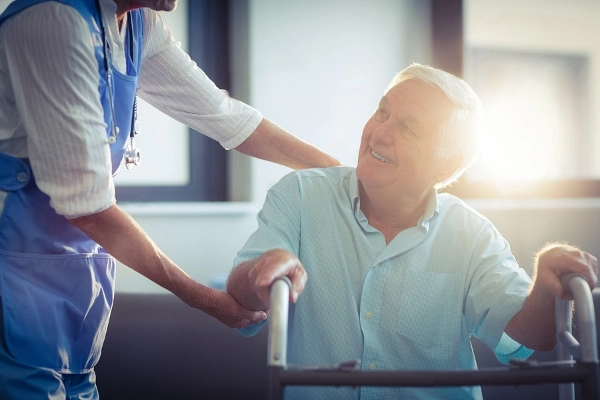
The discussion around bringing someone in professionally to care for the elderly is one that most Indian families take with trepidation and often manage haphazardly. A few principles that work:
- Frame it as support, not replacement: “we want someone to be with you during the day to support — not replace us. You are just supposed to have someone help you with your medications.”
- Involve the elderly parent in the selection: Allowing the aged person passive role over who works as a caretaker — their preference for gender, any additional requirements — goes a long way to make them feel better about this.
- Start with a defined trial: “we find phrases like “let’s test this for two weeks and see how it goes” to generate less resistance than “this is forever.”
- Treat it as a family decision, not an individual one: When the whole family tells older parents that they need to see a professional, they’re more likely to accept care than when just one adult child proposes this.
- Be honest about your own limits: “Your diabetes management and medications would be managed more effectively by a professional than I could, and that means better for you” is honest, respectful, and kind.
The Role Family Members Play in Professional Elder Care Arrangements
Professional elder care works best when it is embedded in an active family structure — not isolated from it. The family’s role in a professional care arrangement includes:
- Regular presence: Visit, call, and be present. The professional caretaker manages the daily clinical and personal care. The family provides the emotional continuity that no professional can replicate.
- Care coordination: Review the daily logs, go to the check-ups and appointments with doctors, talk about changes in the patient by communicating it to both caretaker and agency.
- Honest feedback: If something isn’t working, give the agency honest feedback. While the first placement is not always perfect.
- Respecting the care plan: A caretaker must never override their clinical directions with informal family practices. Please do not bring any special snacks which are against the dietary regime if the doctor has suggested a low-salt diet.
What Caregiver Burnout Looks Like in Indian Families
Family members who manage elderly parents’ care alone — without professional support — frequently develop caregiver burnout syndrome. This is a medical and psychological condition, not a personal weakness. Signs include:
- Persistent fatigue that sleep does not resolve
- Increasing resentment or irritability toward the elderly parent
- Neglecting one’s own health — skipping medical appointments, poor sleep
- Withdrawing from work, social life, or relationships outside the caregiving role
- Feeling trapped or helpless despite continuing to provide care
Caregiver burnout affects care quality. A burnt-out family carer provides worse care than a fresh professional caretaker — this is documented, not anecdotal. Recognising burnout early and introducing professional support before it becomes acute is both self-protective and better for the elderly patient.
Frequently Asked Questions
Q1: Is it culturally acceptable in India to hire a professional caretaker for an elderly parent?
Yes — and it is becoming increasingly common in urban India, including among families with strong traditional values. The question is not whether it is acceptable, but how it is framed. Families who introduce professional care as a supplement to family care — not a substitute for it — consistently report better outcomes for both the elderly patient and the family.
Q2: How do elderly parents typically react to a professional caretaker?
Most elderly parents in India are more accepting of professional caretakers than their adult children expect. Acceptance is highest when: the elderly person has a voice in the selection, the caretaker is of their preferred gender, the arrangement is framed as extra support rather than replacement, and the family remains actively present after the placement begins.
Q3: What is the difference between a caregiver and a nursing attendant for elder care?
A caregiver handles daily personal care, medication reminders, mobility assistance, and companionship — appropriate for medically stable elderly patients. A nursing attendant typically works under nursing supervision and is trained in basic clinical observation. For elderly patients who also need clinical nursing procedures — injections, wound care, catheter management — a qualified nurse is required in addition to or instead of a caregiver.
Q4: How do I know when my elderly parent needs professional elder care?
Indicators include: leaving the elderly person alone for more than a few hours feels unsafe, they have had a recent fall, they are missing medications or taking them incorrectly, their hygiene is declining, they have two or more chronic conditions requiring daily monitoring, or a family member is showing signs of caregiver burnout. Any one of these is a sufficient reason to consider professional elder care.
Conclusion
For many an Indian family, the most loving thing that can be done for elderly parents would be the honest acknowledgement that professional care, through a trained and verified caretaker, does provide what the family cannot: regular daily clinical monitoring; safe mobility management; compliance with medications. That does not diminish the role of the family. It focuses it on what only the family can provide: presence, relationship, emotional continuity, and love. Urmi Care provides verified elder care services across Noida, Delhi, and Gurgaon: elder care services Delhi NCR